Thoughts on "The Master and Margarita" by Mikhail Bulgakov
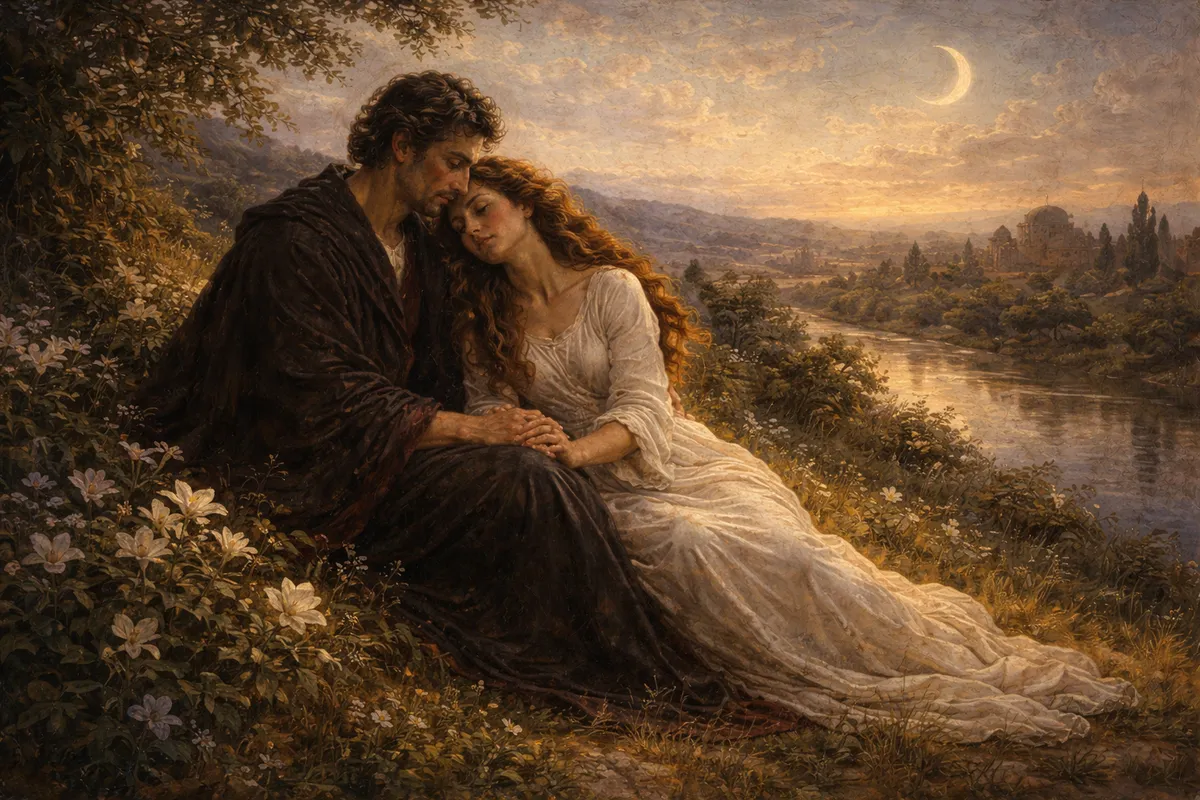 The Master and Margarita — at peace.
The Master and Margarita is a beautiful book, though it may not be evident at first. I picked it up for its intriguing premise — one that gestures toward fantasy and atheism. Moreover, I have been a fan of Russian literature, having read some of Dostoevsky's works; and as such, I thought that this book would expand my experience on such classical literature. At the first chapters, I admittedly struggled reading this book, but once I understand what it really is about, I realized how beautiful this book is. Below, I share my thoughts (spoilers alert) on this book — proudly my first classics read of 2026.

The Structure
The Master and Margarita is one of those novels that resists immediate understanding. For much of Part One, it feels deliberately chaotic: characters appear and vanish, subplots are suspended, and the narrative oscillates between satirical Moscow and a stark retelling of Pontius Pilate's encounter with Yeshua (Jesus). At first, this fragmentation can feel frustrating, especially for readers accustomed to tightly organized novels where every character and scene demands careful tracking. Bulgakov does not reward that kind of reading — at least not immediately.
What becomes clear, however, is that the disorder is intentional. The novel is structured to unsettle before it clarifies. Part One functions as a moral and social destabilization: a world where truth is dangerous, cowardice is normalized, and responsibility dissolves into bureaucracy. Only in Part Two does the narrative begin to cohere, not by explaining the chaos away, but by revealing its underlying logic. When the Jerusalem and Moscow narratives begin to resonate rather than compete, the novel's deeper design comes into focus.
Fantasy and Reality: Yershalaim and Moscow
Coming from Dostoevsky, I initially expected The Master and Margarita to feel "similar," simply because both belong to the Russian literary tradition. This was a naive comparison. Bulgakov's novel operates on a very different logic, blending what appears to be fantasy and reality into a single moral system. The Jerusalem narrative and Woland's supernatural interventions in Moscow may seem fantastical at first, while the Moscow setting presents itself as the novel's "real" world. Yet this distinction quickly begins to collapse.
At first glance, the novel seems divided between two incompatible modes: the satirical, absurd chaos of Moscow under Woland and the austere, grounded narrative of Yershalaim centered on Pilate and Yeshua. As the novel progresses, however, it becomes clear that these are not opposing realities but parallel expressions of the same ethical order. The Moscow chapters exaggerate through comedy; the Jerusalem chapters expose through tragedy. One provokes laughter, the other discomfort. Both, ultimately, pass judgment.
What unites these worlds is not plot but moral structure. In Moscow, people disappear, lie instinctively, and betray one another without reflection; in Jerusalem, violence is quieter but more consequential, hidden behind authority, euphemism, and procedure. Woland's "fantasy" does not distort reality — it reveals it. His interventions merely strip away pretense and expose the moral emptiness already present. Bulgakov suggests that fantasy becomes necessary when reality itself has grown dishonest, and that sometimes only the unreal can tell the truth about the real. It is within this dual structure that Bulgakov’s retelling of Yeshua’s final days gains its full ethical weight
Yeshua Without Salvation
As mentioned, one of the central themes of the novel is the retelling of the final days of Yeshua (Jesus) in Yershalaim (Jerusalem). Alongside Yeshua himself, Bulgakov foregrounds Pontius Pilate, Levi Matthew, and Judas. Readers familiar with the theological Passion narrative will initially recognize the broad outline of events. Yet as the narrative unfolds, it becomes clear that Bulgakov is not simply retelling the story, but deliberately diverging from it. There is no resurrection, no miracles, Judas is murdered rather than condemned by divine judgment, and — most strikingly — Pontius Pilate emerges as the novel's central tragic figure. This retelling is not an act of blasphemy; it is a reframing. Bulgakov replaces theology with ethics, and providence with politics.
In the traditional Christian narrative, the execution of Jesus is inseparable from theology: divinity, resurrection, and redemption frame the event as a cosmic necessity. Bulgakov strips this away with precision. His Yeshua performs no miracles, claims no divine authority, and offers no promise of salvation. There is no resurrection to resolve injustice. What remains is a fully human figure whose goodness is powerless in the face of political fear and administrative convenience. By removing theology, Bulgakov forces the reader to confront the execution not as destiny, but as a failure of moral courage within a system of power.
This shift radically redistributes responsibility. In Bulgakov's retelling, Judas is not punished by God but murdered on the indirect orders of Pontius Pilate — not out of justice, but to quiet Pilate's conscience. Pilate does not explicitly order the killing; instead, he allows the machinery of power to operate while preserving plausible deniability. The execution of Yeshua becomes a political calculation, and the murder of Judas a private attempt at moral compensation. Politics replaces providence. Power, not sin, determines who lives and who dies. The tragedy is no longer metaphysical but ethical: those who know the truth choose safety over courage.
Levi Matthew's role further complicates this moral landscape. Unlike Pilate, Levi is fiercely devoted to Yeshua, yet he repeatedly misunderstands him. Levi seeks retribution rather than mercy, certainty rather than compassion. In this sense, Bulgakov presents a striking inversion: Pilate, the representative of power, understands Yeshua's innocence more clearly than the disciple who follows him. Levi's rigid moral absolutism contrasts with Yeshua's quiet humanity, suggesting that devotion without understanding can become another form of moral failure. Good intentions alone, Bulgakov implies, do not absolve one from ethical blindness.
The contrast with Barabban and the presence of Afranius complete this portrait of a world governed by human systems rather than divine intervention. Barabban, a genuine revolutionary and real political threat, is released, while Yeshua — harmless to the state — is executed. Afranius, Pilate's chief of secret service, understands how violence functions without ever being named. Through him, murder becomes administration and responsibility dissolves into procedure. Jerusalem is terrifying not because it is overtly cruel, but because it is orderly. Nothing supernatural intervenes. The world is governed entirely by human choice — and by the quiet, devastating consequences of choosing silence.
In summary, Bulgakov's retelling is not meant to subvert the Christian story but to bring it down into the logic of real-world systems. By removing miracles, resurrection, and divine intervention, he forces the narrative to operate entirely within human institutions, where injustice is produced through fear, procedure, and moral evasion rather than open cruelty. What the Jerusalem chapters ultimately judge is not belief, but responsibility — and the quiet, devastating choice to remain silent when one knows the truth.
Pilate, Woland, and Margarita: Power, Judgment, and Mercy
At the center of The Master and Margarita lies a meditation on how moral responsibility is exercised — or avoided — under different forms of power. Pontius Pilate represents the tragedy of authority without courage. Unlike the traditional biblical portrayal, Bulgakov's Pilate is not merely weak or confused; he understands Yeshua's innocence with painful clarity. His failure is not cruelty, but evasion. Knowing the right course of action, he chooses order, stability, and self-preservation instead. Through Pilate, Bulgakov suggests that the gravest moral failure is not hatred or violence, but the refusal to act when one knows what is right.
If Pilate embodies moral cowardice under power, Woland represents judgment without illusion. Often mistaken as a simple embodiment of evil, Woland instead functions as a force of moral balance. He does not corrupt; he exposes. His reflections on shadows towards the end of the book make clear that, in Bulgakov's universe, evil is not an aberration to be eradicated but a necessary contrast that renders moral choice intelligible (much like how shadows cannot be eradicated). Woland punishes hypocrisy, greed, and cowardice, but he does not invent them. In a society that has lost its moral bearings, his presence restores clarity — not mercy. Judgment, in Woland's hands, is precise, impersonal, and unyielding.
Margarita (who is my favorite character of the novel) stands in sharp contrast to both figures. Unlike Pilate, she does not evade responsibility; unlike Woland, she does not judge. She acts. Her compassion (as shown to Frieda), willingness to suffer for others, and refusal to seek power or revenge mark her as the novel's moral center. Where Pilate knows the good but fails to choose it, and Woland enforces balance without compassion, Margarita embodies mercy without authority. It is telling that Bulgakov grants the Master peace rather than light, while Margarita earns grace through love. In her, Bulgakov locates the only force capable of transcending both cowardice and judgment.
Taken together, Pilate, Woland, and Margarita form a moral triangle. Pilate shows how power collapses without courage; Woland shows how judgment operates without mercy; Margarita shows how redemption arises without power. Bulgakov does not offer a utopian resolution — evil remains necessary, judgment remains inevitable — but he insists that love and compassion remain possible. In a world governed by systems and silences, Margarita's choice to act becomes the novel's quiet, defiant answer.
The "Creator" and the "Created"
The relationship between the Master and Pontius Pilate briefly reminded me of the anime Re:Creators, where fictional characters step out of their stories and confront the world — and, implicitly, their creators. In that series, the boundary between creation and responsibility collapses: characters inherit the suffering written into them, while creators are forced to reckon with the consequences of what they have imagined and abandoned. While Bulgakov's novel operates in a far more restrained and philosophical register, a similar tension quietly emerges in The Master and Margarita.
The Master creates Pontius Pilate as a literary figure, yet Pilate ultimately feels more morally alive than his creator. Pilate understands Yeshua's innocence, suffers acutely over his failure to act, and is condemned to eternal remembrance because he cannot escape his own conscience. The Master, by contrast, writes truth but retreats from it. Faced with persecution, he burns his manuscript and withdraws from the world rather than endure the cost of authorship. Bulgakov's inversion is striking: the "created" bears responsibility more fully than the "creator," while the author seeks escape from the moral weight of his own vision.
This contrast becomes even sharper at the novel's conclusion. The Master is granted peace — rest without transcendence — a release from suffering, but not a moral elevation. Pontius Pilate, however, receives something different. His long-awaited crossing of the bridge is not merely peace, but release through acknowledgment: centuries of remembrance culminate in motion, not rest. If the Master's peace signifies withdrawal from responsibility, Pilate's crossing signifies the end of moral paralysis. Bulgakov thus draws a subtle but crucial distinction — peace can be granted, but moral resolution must be endured.
The Context
As we wrap this up, it must not be forgotten how the book came to be, for great works are never created in a vacuum. Read in its historical context, The Master and Margarita functions not only as a philosophical novel but also as a devastating critique of Stalinist society. Its depictions of censorship, fear, denunciation, and bureaucratic violence are unmistakable, even when filtered through satire and fantasy. The Moscow chapters, with their vanished citizens, anonymous accusations, and absurd institutional rituals, closely mirror the atmosphere of suspicion and surveillance that defined everyday life under Stalin. Satire here is not escapism; it is a survival strategy.
It must be noted that the novel was not published during Bulgakov's lifetime — this gives the novel a deeper meaning. Bulgakov wrote The Master and Margarita knowing full well that it could not appear openly in his time. His works were censored, his plays withdrawn, and his career repeatedly obstructed by the state (which ultimately affected his health). The novel itself endured cuts and delayed publication long after his death. In this light, the Master’s burned manuscript is not merely a fictional device but a reflection of Bulgakov's own experience as a writer silenced by power. The famous assertion that "manuscripts don't burn" (as mentioned by Woland to the Master) is therefore not naive optimism; it is defiance. Truth may survive, Bulgakov suggests, but survival does not guarantee recognition, safety, or happiness.
This context matters because Stalin-era literature was expected to serve ideology. Writers were pressured to produce works that celebrated collectivism, industrial progress, and the moral triumph of Communism. Ambiguity, irony, and metaphysical inquiry were treated as threats. Against this backdrop, Bulgakov's refusal to write "useful" literature becomes an act of resistance. His novel offers no heroic workers, no redemptive future, and no ideological reassurance. Instead, it exposes how systems that demand moral certainty often produce fear, conformity, and silence.
Seen this way, The Master and Margarita is not simply a fantasy novel set against a political background; it is a work shaped by censorship at every level — in its composition, its themes, and its fate. Bulgakov does not deny that truth can endure, but he refuses to romanticize endurance itself. The novel's world is one where truth survives, love persists, and justice remains elusive. In Stalinist society, Bulgakov implies, the tragedy is not that truth is destroyed, but that it is allowed to exist only in whispers, manuscripts, and dreams.
Ultimately, The Master and Margarita is not a novel that reveals its meaning all at once. It demands patience, a willingness to abandon rigid reading habits, and an acceptance of delayed synthesis. But for readers willing to trust its structure, the reward is profound. By the end, the novel does not merely tell a story — it leaves behind a moral diagnosis of power, evil, and responsibility that feels as unsettling today as it must have felt in Bulgakov's time. ###