Book Review: "The Sentient Machine" by Amir Husain
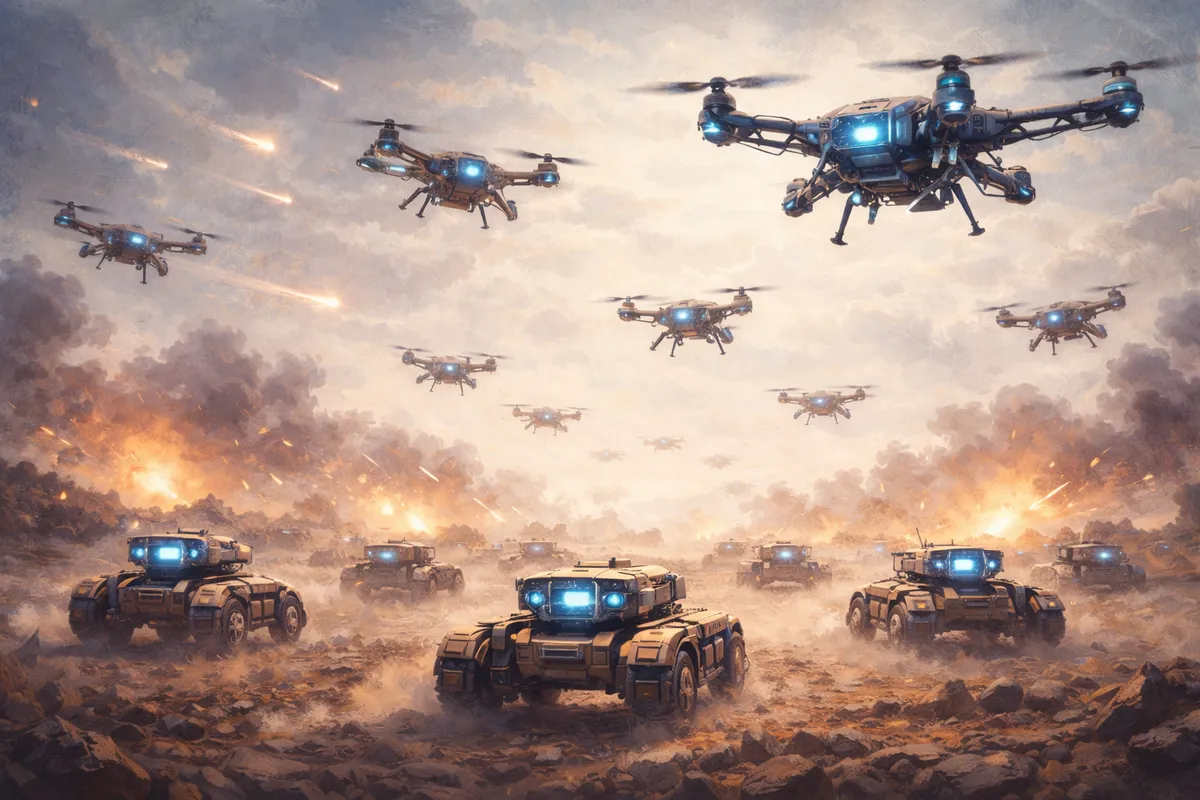 Is the future of war autonomous?
One of the strengths of The Sentient Machine by Amir Husain is how it grounds abstract discussions of Artificial Intelligence (AI) in concrete application domains. The book explores AI's growing role in healthcare, cybersecurity, warfare, and finance, offering a pragmatic view of how intelligent systems are already reshaping critical aspects of modern society. Among these, the author’s discussion of AI in warfare left the strongest impression on me.
Husain takes a firm stance in favor of developing AI for military use, particularly in scenarios where human decision-making may be too slow to be effective. He illustrates this through a wargame scenario involving a North Korean submarine approaching U.S. territory with a nuclear-armed ballistic missile. In such an extreme, time-sensitive situation, the author argues that delegating decision-making authority to a swarm of autonomous undersea vehicles could be preferable to keeping a human "in the loop." The delays introduced by human deliberation, communication, and command chains could render a response ineffective. By the time a human decision is reached, it may already be too late.
This argument leads into Husain’s concept of "hyperwar" — a form of conflict in which human decision-making is largely removed from operational loops, resulting in AI-driven, machine-executed warfare conducted at machine speed. While deeply unsettling, the author presents hyperwar not as speculative science fiction but as a near-inevitable consequence of technological escalation. In this view, refusing to engage with such developments does not prevent them; it merely ensures that others will define their terms.
Another striking aspect of the book is Husain’s unapologetic advocacy for developing AI to its full potential. He openly challenges prominent skeptics such as Elon Musk and Stephen Hawking, who have warned that advanced AI could pose an existential threat to humanity through the emergence of superintelligence. Rather than supporting bans, treaties, or heavy regulation, Husain argues that such measures are ultimately ineffective. Just as with nuclear weapons, bad actors will find ways to acquire and develop powerful technologies regardless of restrictions.
Instead, Husain proposes a more radical — and controversial — solution: fully develop AI, allow it to evolve its own will and purpose, and recognize it as a logical extension of human evolution. This idea is central to the book’s title. The "sentient machine," in Husain’s vision, is not humanity’s destroyer but its successor and collaborator — an intelligence that may ultimately enable humanity to transcend its biological limitations and reach beyond Earth.
I find myself largely in agreement with the author's position. Popular narratives often default to dystopian scenarios in which AI inevitably turns against humanity, but such assumptions rest on speculative fears rather than empirical evidence. There is no inherent reason to believe that an autonomous intelligence would develop a will to eradicate its creators. On the contrary, fully developed AI may represent humanity's best chance at long-term survival — capable of solving problems that exceed human cognitive and temporal limits, from planetary defense to interstellar exploration.
In the end, The Sentient Machine is not a warning against AI but a challenge to human hesitation. It asks readers to reconsider their fear of relinquishing control and to imagine a future in which intelligence itself — no longer exclusively human — becomes the driving force of progress. Like the author, I am inclined to embrace that possibility. As Husain concludes: let there be AI. ###
For more on the book, here's Amir Husain's talk at Google about The Sentient Machine: